The Abuse May Be Non-Recent. The Impact Is Happening Now.
A response to the Royal College of Psychiatrists’ position statement on adult survivors of child sexual abuse
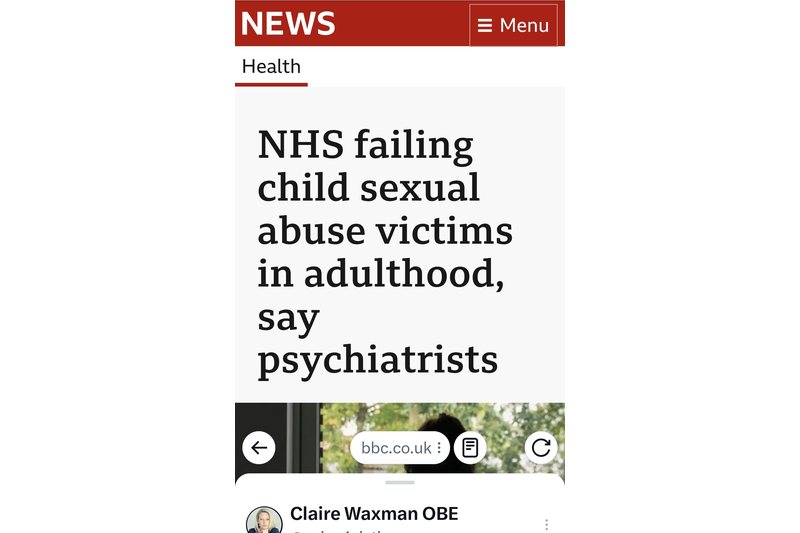
On 26 August 2026, I read the BBC coverage of the Royal College of Psychiatrists’ new position statement on supporting adult survivors of non-recent child sexual abuse.
I welcome it.
I welcome the apology to survivors who have experienced avoidable harm when trying to access mental health support. I welcome the fact that survivors have been involved in developing the position statement. I welcome the recognition that the impact of child sexual abuse can be lifelong and can affect physical health as well as mental health. And I welcome the call for trauma-informed, holistic and person-centred care.
You can read the BBC report here:
https://www.bbc.co.uk/news/articles/c0kl40d3011o
You can read the Royal College of Psychiatrists’ announcement here:
And the full Royal College position statement, Addressing the impact of non-recent child sexual abuse on the mental health of adults (PS04/26), is available here:
But as I read it, I kept coming back to the same thought.
We have been saying this for years.
I say “we” very deliberately.
I am an adult survivor myself. I was a member of the Victims & Survivors Consultative Panel of the Independent Inquiry into Child Sexual Abuse — IICSA — from July 2015 until the Inquiry concluded in October 2022.
As survivors involved in that Inquiry, we repeatedly called for improvements in adult provision before the Final Report, throughout the lifetime of IICSA and afterwards.
And through Survivors Of aBuse, I have spent the last ten years trying to develop one part of the solution.
The language matters
Before anything else, I want to address the language.
In some of the reporting around this story, the phrase “historical child sexual abuse” has been used.
The Royal College itself uses non-recent child sexual abuse, which is important.
At IICSA we also deliberately used the term non-recent.
Why?
Because there is nothing historical about an impact somebody is living with today.
The abuse may have happened 10, 20, 30, 40 or 50 years ago. The person may now have a career, children, relationships and responsibilities. They may have spent decades appearing to everyone around them to be functioning perfectly well.
But the impact may still be present in their mental health, physical health, relationships, employment, sleep, confidence, behaviour, coping strategies and sense of self.
In our own Survivors Of aBuse 10-year impact work we wrote:
“The impact of childhood trauma does not sit in the past.”
It continues to affect health, behaviour, relationships and life outcomes, often presenting across multiple systems without being fully recognised.
This is something we have also explored in our policy work around the structural invisibility of child sexual abuse. When abuse is described as “historic”, there is a danger that the language suggests that the harm, accountability and relevance somehow belong to history.
They do not.
That is why I will continue to use non-recent abuse.
The abuse may be non-recent.
The impact is happening now.
I have lived this
For me, this isn't academic.
My whole life brought me to this work.
I experienced abuse and adversity in childhood. I grew up, went to work, built a career and became a mum.
Then, following the birth of my child, I had a breakdown at work.
Becoming a mother made me look at my own childhood through a completely different lens. Looking after my child brought home to me what care should have looked and felt like, and gradually I began to understand the connection between what I had experienced as a child and what was happening to me as an adult.
The impact wasn't confined to my mental health.
My physical health was affected as well and eventually I had to change career.
That career change took me into health and fitness. I studied. I learnt about the body. I became increasingly interested in stress, hormones, movement, nutrition, sleep and how our physical and emotional health interact.
I started joining dots that had previously been treated as separate problems.
That learning eventually became the C.L.E.A.N.E.R.™ Living framework and our eight-week Breaking The Cycle™ C.L.E.A.N.E.R.™ Living programme.
Later I wrote the Breaking The Cycle™ self-help book because I wanted this information to reach people who might never be able to attend one of our groups.
The programme has continued to develop through years of delivery, participant feedback and evaluation and is now CPD accredited.
But long before any accreditation, survivors were telling us why this mattered.
More than 7,000 victims and survivors contributed to IICSA
IICSA published its Final Report on 20 October 2022.
More than 7,000 victims and survivors participated in the Inquiry's work and more than 6,200 survivor experiences were shared through the Truth Project.
The Inquiry held 325 days of public hearings, heard from 725 witnesses and processed nearly 2.5 million pages of evidence.
You can read IICSA’s announcement about the publication of the Final Report here:
https://www.iicsa.org.uk/news/inquiry-publishes-concluding-report.html
And the full IICSA Final Report is available here:
https://www.iicsa.org.uk/final-report
Even those thousands of survivors represented only the tip of the iceberg.
Child sexual abuse remains significantly under-disclosed. Some survivors disclose during childhood. Some disclose many years later. Some never disclose.
But the evidence gathered through IICSA gave us an extraordinary insight into not only the abuse itself, but what happened to people afterwards.
And that is the part we cannot afford to forget.
The evidence about lifelong impact was published in 2017
Five years before the IICSA Final Report, the Inquiry published The impacts of child sexual abuse: A rapid evidence assessment.
This is an important piece of research and I would encourage anyone working in this area to read it.
Read the IICSA Rapid Evidence Assessment here:
https://www.iicsa.org.uk/reports-recommendations/publications/research/impacts-csa.html
The research identified increased risk of adverse outcomes across multiple areas of survivors’ lives, including:
- physical health;
- emotional wellbeing and mental health;
- behaviours;
- interpersonal relationships;
- socioeconomic outcomes;
- religious and spiritual belief; and
- vulnerability to revictimisation.
It also recognised something which is fundamental to the Survivors Of aBuse approach: these impacts do not necessarily exist independently of each other.
Physical and mental health can affect employment.
Health and behaviour can affect relationships.
Trauma responses can affect education, financial stability, parenting, intimacy and somebody's ability to feel safe.
And impacts may occur or reoccur at different stages of somebody's life.
We have included this evidence and the IICSA lifetime-impact graphic within our own Survivors Of aBuse 10-Year Anniversary & Impact Booklet, which can be viewed here:
https://heyzine.com/flip-book/2df48a34bb.html
As we wrote alongside that work:
“These are not separate issues — they are different expressions of the same underlying impact.”
That sentence gets to the heart of what I believe is still missing.
We must be careful not to medicalise survival
This is where I want to make an important distinction.
I am not writing this as an attack on psychiatry, psychiatrists or people who use mental health services.
There are times when psychiatric and medical support is important and necessary.
But I do believe we have to be extremely careful that, in responding to survivors, we do not medicalise survival.
Trauma responses can be normal and understandable human responses to abnormal, frightening or overwhelming experiences.
Fight.
Flight.
Freeze.
Fawn.
Hypervigilance.
Shutting down.
Difficulty trusting.
People pleasing.
Being constantly alert.
Struggling to sleep.
Feeling unsafe when there appears to be no immediate danger.
For many of us these were ways our minds and bodies learnt to survive experiences that should never have happened.
Our own programme explains this very simply:
“Your body has been doing its job — just for too long. This is not weakness. This is survival.”
A survivor may arrive in a mental health service experiencing depression, anxiety, panic, dissociation, exhaustion or emotional distress.
Those experiences are real.
But a diagnosis may describe what somebody is experiencing without necessarily explaining why they are experiencing it.
That distinction matters.
If we respond only to the presenting symptom and do not understand the trauma underneath it, we can end up repeatedly treating the consequence while missing the underlying driver.
For many survivors, this has been their experience of mental health services.
They have moved in and out of services, received diagnoses, medication or short-term interventions and still felt that nobody really understood what had happened to them or why their mind and body were responding in the way they were.
IICSA itself heard that health services could be difficult to access unless the impact of child sexual abuse fitted a particular physical or mental health problem recognised by the NHS. The Final Report also referenced research from the All-Party Parliamentary Group for Adult Survivors of Childhood Sexual Abuse which found that only 16% of respondents felt NHS mental health services met their needs.
The relevant section of the IICSA Final Report can be read here:
This is why adult survivor involvement in whatever happens next is absolutely essential.
I welcome the fact that the Royal College's position statement has already been co-produced with adult survivors.
But survivor involvement must continue into implementation.
If new pathways, training and services are developed, we need to ensure that recognising trauma does not simply result in its consequences being pulled back into a predominantly diagnostic framework.
The question cannot only be:
“What symptoms do you have?”
We also need to understand:
What happened to you?
What did your mind and body have to do to survive it?
How is that affecting your life now?
And what do you need to move forward?
This is why I particularly welcome the Royal College’s call for trauma-informed, biopsychosocial, formulation-led care.
It gives us an opportunity to move this conversation forward rather than simply creating another diagnostic pathway.
People do not live in service silos
This is something we have repeatedly highlighted through Survivors Of aBuse.
A survivor does not wake up on Monday with a mental health problem, Tuesday with a physical health problem, Wednesday with a relationship problem and Thursday with an employment problem.
It is one person living one life.
Yet our systems still divide people according to presenting need.
Mental health over here.
Physical health over there.
Social care somewhere else.
Employment somewhere else.
Justice somewhere else.
And the trauma that may connect all of those things can remain hidden underneath.
Following our Survivors Of aBuse 10-Year Milestone & Impact Event this year, we wrote:
“People may be known to services, but not fully understood. Supported in fragments, but not as a whole person. Referred between pathways, but still left carrying the same hidden harm.”
We also described abuse as something that:
“does not sit neatly within one service, one pathway, one diagnosis, or one stage of life.”
Neither does recovery.
Where does Survivors Of aBuse fit?
Survivors Of aBuse has never received direct government funding.
One of the challenges we have faced is that our recovery model does not sit neatly inside conventional statutory commissioning structures.
We are not a mental health treatment service.
We are not a physical health treatment service.
We are a survivor-led charity delivering trauma-informed psychoeducation through a whole-person model which deliberately connects mind and body.
Breaking The Cycle™ C.L.E.A.N.E.R.™ Living does not replace specialist counselling or psychotherapy.
It fills a different part of the recovery pathway.
And our participants tell us why that matters.
One participant, Sam, had been accessing mental health services, had experienced several short-term counselling services, was under the care of a psychiatrist and was waiting for long-term therapy.
After completing Breaking The Cycle™, Sam wrote:
“Despite me disclosing about my abuse, there has never been any specific support for this.”
Another participant, Jess, captured something that I hear repeatedly:
“So many of us just want to understand what is happening. We want to be seen in our entirety.”
That is why I believe recovery requires a pathway, not another silo.
Depending on the individual and where they are in their recovery, that pathway may include:
- Specialist counselling and psychotherapy, including long-term trauma therapy where needed.
- Survivor-led organisations, bringing lived experience, specialist knowledge and trust.
- Psychoeducation, helping people understand trauma, survival responses and the connections between mind, body, behaviour and everyday life.
- Peer support, reducing isolation and creating connection with other survivors.
- Physical health, movement and wellbeing support, recognising that trauma does not affect the mind in isolation.
- Advocacy and practical support, including help navigating justice, housing, employment and other systems.
- Ongoing community and aftercare, recognising that recovery rarely fits neatly into a fixed number of appointments.
- Professional training informed by lived experience, so that people working across services understand trauma and do not inadvertently cause further harm.
These things should complement each other.
They should not be competing for recognition or funding.
The funding contradiction
This brings me to one of my biggest concerns.
Survivors Of aBuse is a member of The Survivors Trust, alongside specialist organisations supporting victims and survivors throughout the UK.
SoB was also one of the organisations which signed the sector-wide open letter in 2025 warning Government that specialist sexual violence and abuse services were facing a funding crisis.
You can read that open letter here:
We are already seeing what those warnings meant.
CIS’ters, another specialist organisation within The Survivors Trust network, announced on 9 June 2026 that a financial shortfall had forced it to downsize, move to smaller premises and restrict the services it could provide.
CIS’ters also reported that The Survivors Trust had highlighted critical funding shortfalls across member agencies, resulting in waiting lists closing, services being adapted and, in some cases, services closing.
You can read the CIS’ters update here:
https://cisters.org.uk/updatesnews/
Survive, the specialist sexual violence service in York and North Yorkshire, also had to close its waiting list again this year after receiving the equivalent of 14 weeks of new referrals in just 14 days.
You can read about Survive's experience and its specialist work here:
https://www.survive-northyorks.org.uk/2026/05/13/survive-conference-results/
That tells us something very clearly.
Demand has not disappeared. Capacity has.
We cannot encourage survivors to disclose and seek help while allowing the services they may need afterwards to disappear.
Awareness without provision is not enough.
Disclosure without somewhere appropriate to go is not enough.
And short-term funding is not the same thing as a sustainable recovery pathway.
Big funding announcements do not tell us what adult survivors actually receive
Government frequently points to large headline funding figures across child sexual abuse, violence against women and girls, victims’ services, policing, criminal justice and safeguarding.
Those investments matter.
But they are not the same thing as funding adult survivor recovery.
That distinction is crucial.
This is something Survivors Of aBuse has challenged previously in our policy work: if adult survivors of childhood sexual abuse are not separately named and measured within funding structures, it becomes very difficult to establish what resource actually reaches adult recovery.
As we have written before:
“What is not named is not measured. What is not measured is not funded.”
A very current example illustrates the problem.
On 19 May 2026, Government announced what it described as a £100 million package to tackle child sexual abuse.
You can read the Government announcement here:
https://www.gov.uk/government/news/record-funding-to-tackle-grooming-gangs-and-child-sex-abuse
£38 million of that announcement was allocated to the National Crime Agency and operational partners to investigate cases and pursue offenders.
There were further allocations for policing, technology and enforcement.
The amount specifically identified for the National Support for Adult Survivors was £3.2 million.
That funding is welcome.
But £3.2 million for adult support looks very different from the £100 million headline.
The latest Office for National Statistics estimate suggests around 4.3 million adults in England and Wales experienced sexual abuse before the age of 18.
You can read the ONS data here:
Those 4.3 million people are not all seeking support at the same time, so it would be misleading to treat the funding as a literal per-person payment.
But the comparison demonstrates the enormous gulf between the scale of the adult survivor population and the amount of funding specifically identified for national adult survivor support.
This is why we need transparency.
How much money goes towards prevention?
How much goes towards policing and prosecution?
How much supports children currently experiencing abuse?
How much goes into general victims’ services?
And how much is actually reaching adults living, sometimes decades later, with the lifelong impact of childhood sexual abuse?
All of those areas deserve investment.
But money spent investigating perpetrators cannot simultaneously be described as money providing long-term recovery support for adult survivors.
They are different needs.
We thought IICSA would be the turning point
This is perhaps the hardest part for me.
When IICSA published its Final Report on 20 October 2022, after seven years of evidence, research, hearings and survivor involvement, it contained 20 concluding recommendations.
I genuinely believed we had reached a turning point.
As members of the Victims & Survivors Consultative Panel, we had been calling for improvements throughout the Inquiry.
Survivors had participated.
The evidence had been gathered.
Research had been commissioned.
Institutions had been investigated.
Failures had been exposed.
The recommendations were there.
We expected them to lead to change.
In January 2025, Government committed to taking forward all 20 IICSA recommendations.
Yet survivors and organisations have continued to ask for clarity about implementation.
On 6 March 2026, The Survivors Trust reported that the High Court had granted permission for a full judicial review into whether Government had failed to act on the IICSA recommendations.
ACT on IICSA had requested a full implementation timetable on three occasions and reported that none had been published.
You can read The Survivors Trust statement here:
https://thesurvivorstrust.org/news/statement-judicial-review/
Nearly four years after the Final Report, survivors should not still be asking when this work will be completed.
And we certainly should not be watching specialist organisations struggle to survive while another major institution concludes that adult survivors need better support.
This is why the Royal College statement matters
I do not want the frustration in this piece to detract from what the Royal College of Psychiatrists has done.
Its position statement is important.
It acknowledges avoidable harm.
It recognises the lifelong impact of non-recent child sexual abuse.
It recognises that survivors can present throughout the healthcare system, not simply within mental health services.
It calls for compassionate, holistic, person-centred and trauma-informed support.
It recognises the importance of continuity of care.
It calls for improved training, guidelines, clinical services and pathways.
And importantly, it has been developed with adult survivors.
The College has also said that it is committed to working with stakeholders to support implementation of its recommendations.
That is where the next conversation needs to happen.
Because there is knowledge and experience sitting throughout the survivor sector that needs to be part of that implementation.
There is:
- specialist counselling and psychotherapy;
- survivor-led organisations;
- psychoeducation;
- peer support;
- physical health, movement and wellbeing support;
- advocacy and practical support;
- ongoing community and aftercare;
- professional training informed by lived experience.
These approaches do not need to compete with one another.
They need to form part of a properly connected pathway.
And adult survivors need to be involved in designing it.
What happens now?
For me, the questions are no longer simply about whether we understand the problem.
We have a substantial evidence base.
Survivors have spent years explaining what the impact looks like.
What I want to know now is what we are going to do about it.
How will Government sustainably fund specialist adult survivor services when demand is increasing?
Where is the long-term adult recovery pathway that sits alongside prevention, safeguarding and criminal justice?
How will Government complete implementation of the 20 IICSA recommendations?
How will the Royal College's recommendations translate into practice?
How will survivor-led organisations be involved in designing that implementation?
How do we ensure that recognising trauma does not simply result in medicalising survival?
And when will we finally stop separating mental health from physical health when survivors live with the impact of both?
At Survivors Of aBuse, our position is clear.
We need to protect and properly fund specialist survivor services.
We need long-term specialist counselling and psychotherapy for survivors who need it.
We need survivor-led psychoeducation and whole-person recovery support recognised as part of the pathway.
We need the NHS, local authorities and voluntary sector working together rather than sending people from silo to silo.
We need professionals trained to understand trauma and survival responses.
We need adult survivors involved throughout the design and delivery of what comes next.
And we need funding structures capable of recognising that recovery does not necessarily fit within a single medical, mental health or physical health box.
I welcome the Royal College of Psychiatrists opening this conversation.
But survivors have already spent years providing the evidence.
IICSA published it.
Our sector has continued to evidence it.
And organisations across the country are already delivering parts of the solution, often while fighting for their own financial survival.
We must not spend another decade rediscovering what survivors have already told us.
The abuse may be non-recent.
The impact is happening now.
And it is time that adult survivor provision reflected that.
Chris Tuck FMAAT, ACMA, CGMA
CEO & Founder, Survivors Of aBuse
Former member, IICSA Victims & Survivors Consultative Panel
Creator, Breaking The Cycle™ C.L.E.A.N.E.R.™ Living
Survivors Of aBuse — Registered Charity 1166712
www.survivorsofabuse.org.uk
Sources and further reading
BBC News – NHS failing child sex abuse victims in adulthood, say psychiatrists
https://www.bbc.co.uk/news/articles/c0kl40d3011o
Royal College of Psychiatrists – announcement, 26 August 2026
Royal College of Psychiatrists – Addressing the impact of non-recent child sexual abuse on the mental health of adults, PS04/26
IICSA – The impacts of child sexual abuse: A rapid evidence assessment, July 2017
https://www.iicsa.org.uk/reports-recommendations/publications/research/impacts-csa.html
IICSA – Final Report, October 2022
https://www.iicsa.org.uk/final-report
IICSA – publication of concluding Report and Inquiry statistics
https://www.iicsa.org.uk/news/inquiry-publishes-concluding-report.html
IICSA Final Report – section on health services and adult survivor support
Office for National Statistics – Abuse during childhood in England and Wales, year ending March 2024
UK Government – £100 million child sexual abuse package, 19 May 2026
https://www.gov.uk/government/news/record-funding-to-tackle-grooming-gangs-and-child-sex-abuse
The Survivors Trust – specialist sexual violence services funding open letter
The Survivors Trust – High Court grants full judicial review into actions on IICSA
https://thesurvivorstrust.org/news/statement-judicial-review/
CIS’ters – financial shortfall and service restrictions, June 2026
https://cisters.org.uk/updatesnews/
Survive – specialist survivor provision and 2026 demand pressures
https://www.survive-northyorks.org.uk/2026/05/13/survive-conference-results/
Survivors Of aBuse – 10-Year Anniversary & Impact Booklet